Scored from your page.
An agent that fixes it.
Byline is an AI search readiness tool for SEOs. It scores whether a page can be retrieved and cited, in code, with the evidence under every finding.
30-day money-back guarantee. No questions asked.
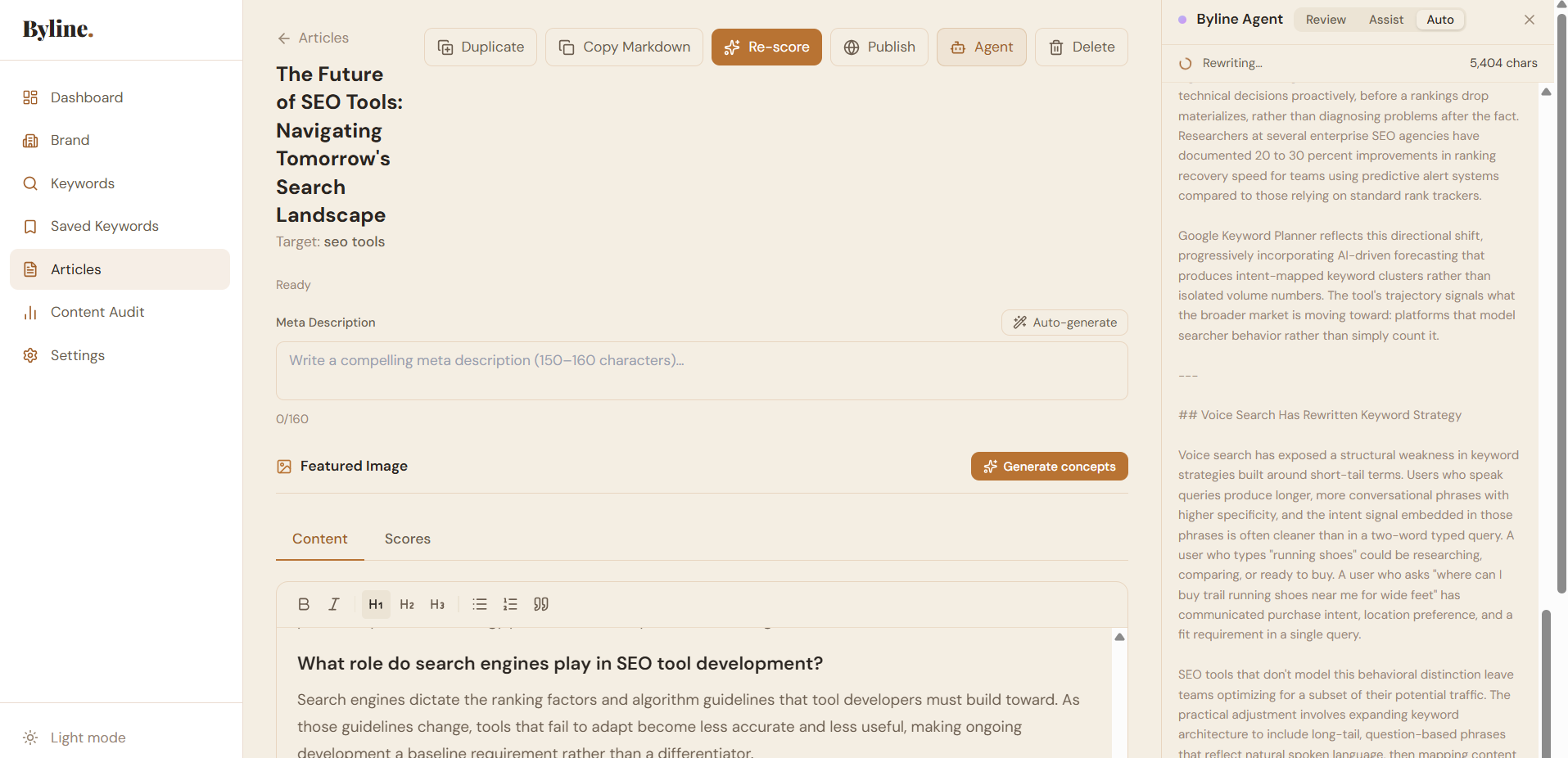
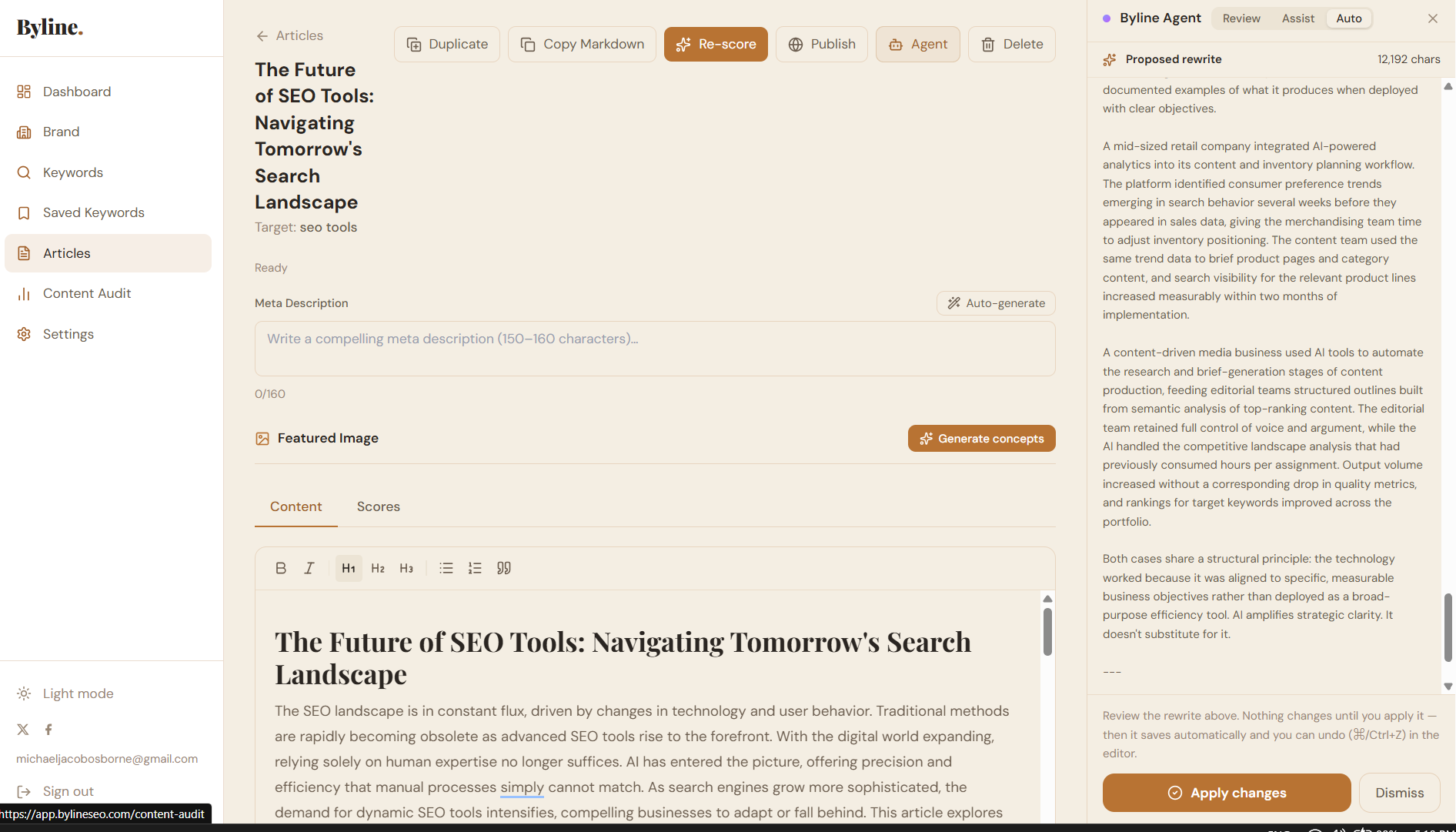
The editorial agent, live inside your editor
What does Byline do?
Byline reads a page the way a crawler does and scores two things. Retrievable is a score out of 100 for whether an engine can reach the page, parse it and lift a clean passage out of it. Citable is a band for whether a lifted passage carries anything that points back to you, such as a named author or data only you publish.
Every finding shows the evidence it was scored from, down to the heading text as found or the line in your robots.txt that decided a crawler's access. When too little of a page can be read, Byline publishes no score rather than a guess. The same rubric scores drafts in the editor before you publish them.
Retrievable vs citable
The two halves fail for different reasons and need different fixes, so Byline reports them separately and never blends them into one number.
| Retrievable | Citable | |
|---|---|---|
| The question | Can an engine reach the page, parse it and lift a clean passage? | If a passage is lifted, does anything in it point back to you? |
| Reported as | A score from 0 to 100 | A band: Strong, Adequate, Weak or Absent |
| What is checked | Access 30, Parseability 25, Chunkability 25, Extractability 20 | Six attribution signals, from named authorship to original evidence |
| When evidence is thin | No score below 60% of the points being assessable | Marked unable to assess, never scored as absent |
Why does Byline score the page instead of AI answers?
Because citations move when nothing on the page changes. Otterly.AI reported that between July and September 2026 Reddit's share of ChatGPT citations fell 94% while its share of Perplexity citations rose 86%. In Semrush's 30-day test, Google AI Mode cited 48 of 81 unchanged pages on day six and 21 on day thirty.
A single visibility number averages those movements into something that happened to nobody. What stays still, and what you can change, is the page. So the score comes from deterministic code reading your HTML. A language model writes the explanation beside a finding and nothing else. It cannot set a score, a status or a band.
Sources: Otterly.AI, 1 October 2026 and Semrush, 10 December 2025.
What do other AI readiness scores report?
Otterly.AI, an AI search monitoring vendor, also publishes a content readiness score. Its public API describes that score as 13 named dimensions, such as specificity and paragraph cohesion, each returned as a number from 0 to 100 with a free-text explanation.
The schema has no field for text quoted from the page, and it does not say how the dimensions combine into the overall score. Otterly also runs prompt monitoring across AI engines, which is a different product; this is about its readiness score only. The schema is public, under PublicApiContentCheckContentAnalysis in Otterly's API specification, checked on 11 October 2026.
How is Byline's approach different?
Each Byline finding names its threshold and quotes what it found. 'Self-contained sections 0/8: no section pairs a heading with enough prose to stand alone (target: 8+ sections of 40+ words)' is a line you can check in a browser in a minute. Factors that cannot be checked are marked unable to assess and left out of the total, never scored as zero.
Every report records the engine version that produced it, currently 2026.12, so two runs can be checked for whether the rubric moved between them. A language model never decides a score, and the score is withheld when the page cannot support one.
What did we find on eight SEO agency homepages?
In October 2026 we audited the homepages of eight SEO agencies in the UK and US. All eight could be read well enough to score, between 62 and 79 on engine 2026.10. Wherever the crawler check could be attributed, every AI crawler was served the page. On two sites an ordinary browser request was refused too, so every crawler row there was reported as unknown, not blocked.
The gaps were on the page. Seven of the eight had fewer than eight sections that stand alone when quoted. Four had no heading phrased as a question. One had its main Organization markup fail to parse because of a line break inside a text string.
Those runs also exposed errors in our own engine: a CAPTCHA script on a contact form read as a bot challenge, and a legal company name searched for instead of the trading name. We fixed both and re-ran all eight before using any finding.
From keyword to scored draft in one workflow.
Research, generate, score and fix, all without leaving Byline.
Discover the right keywords
Tell the discovery agent your topic and audience. It asks the right questions and generates 15–20 targeted keyword seeds before touching the API, so your results fit your topic.
Generate an article that actually fits
Choose your target word count. Byline generates a fully structured, SEO-optimized article matched to the keyword's search intent, then scores how retrievable and citable it is before you publish.
Let the agent fix what the scorer flagged
Select any section. Tell the agent to rewrite it. The fix drops in directly, with no copy-paste and no leaving the editor. The agent also surfaces content gaps and suggests your next article.
How does the editorial agent fix what the scorer flags?
The scorer finds the problem in code. The agent drafts the fix inside your editor, and you choose whether to apply it.
Review mode
Ask the agent to review an article. It reads the full draft and the scorer's findings, then suggests changes that quote the lines they mean.
Assist mode
Select any paragraph. Give an instruction. The agent rewrites it in-place and applies it to your editor with one click. No copy-paste.
Score-based shortcuts
Failed a check? One click sends the agent straight to the fix: “Add a FAQ section targeting common questions about [keyword].”
Agent Memory
The agent keeps a memory of what it has already told you, across sessions and articles.
Rewrite this to include the primary keyword in the first sentence
Lock in founder pricing. Forever.
The first 100 subscribers get reduced pricing locked for life. Your rate never increases, even as we add features and raise prices.
Locked forever at this rate
Research, generate, and score articles. 8 articles per month, 10 keyword sessions.
Claim Starter Founder spotLocked forever at this rate
Full agent access, 30 articles/mo, Assist mode, score-based fixes, persistent memory.
Claim Growth Founder spot30-day money-back guarantee. Founder pricing is locked for the lifetime of your subscription.
Simple pricing. Start small, scale when you're ready.
Pick a plan and score every draft before you publish it. Upgrade or cancel anytime.
Research, generate, and score articles. 8 articles per month, 10 keyword sessions.
Get startedFull agent access, 30 articles a month, Assist mode, and persistent memory.
Get started30-day money-back guarantee. No questions asked.
Start with a keyword. Leave with a draft you can check line by line.
30-day money-back guarantee. No questions asked.